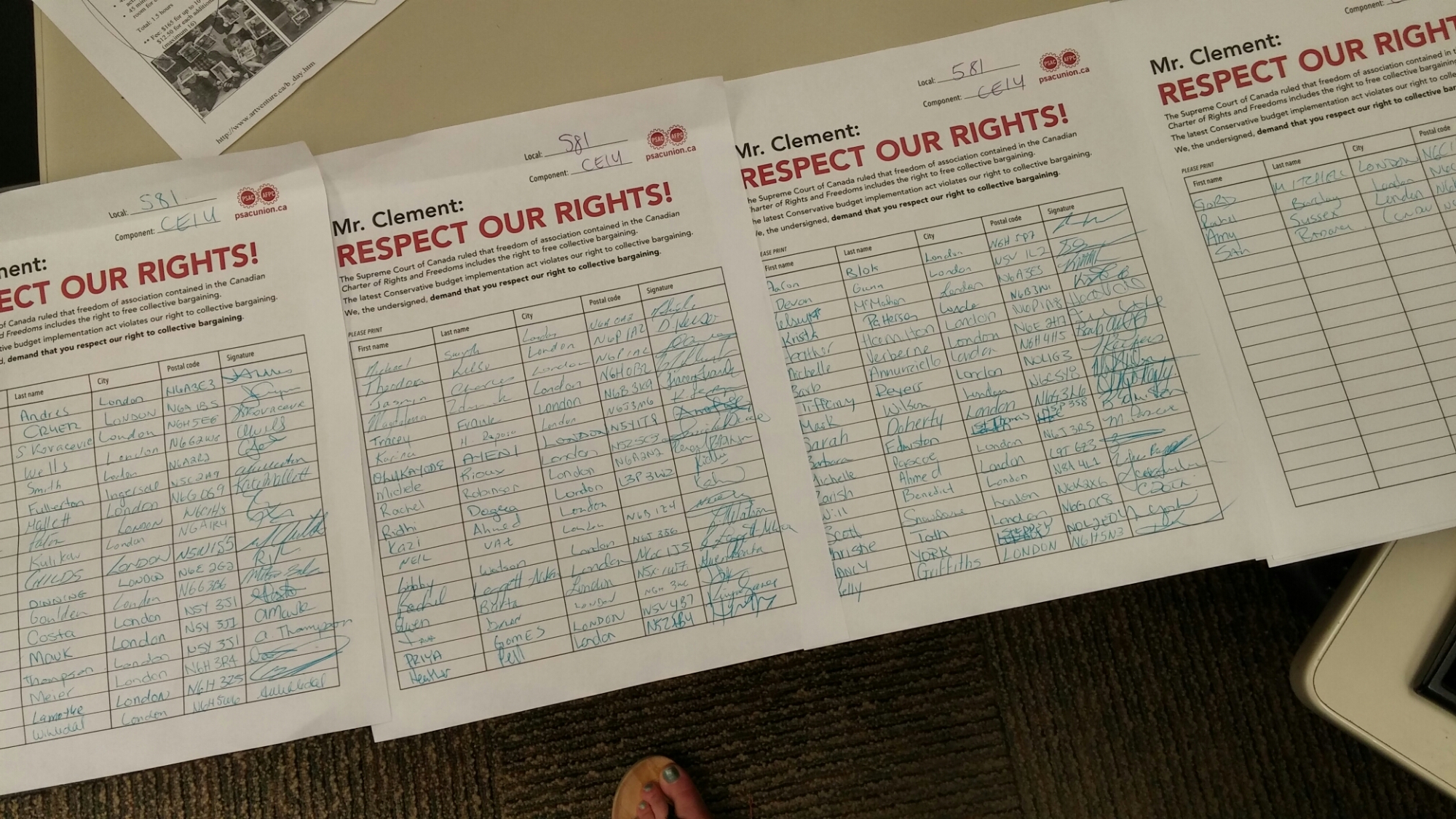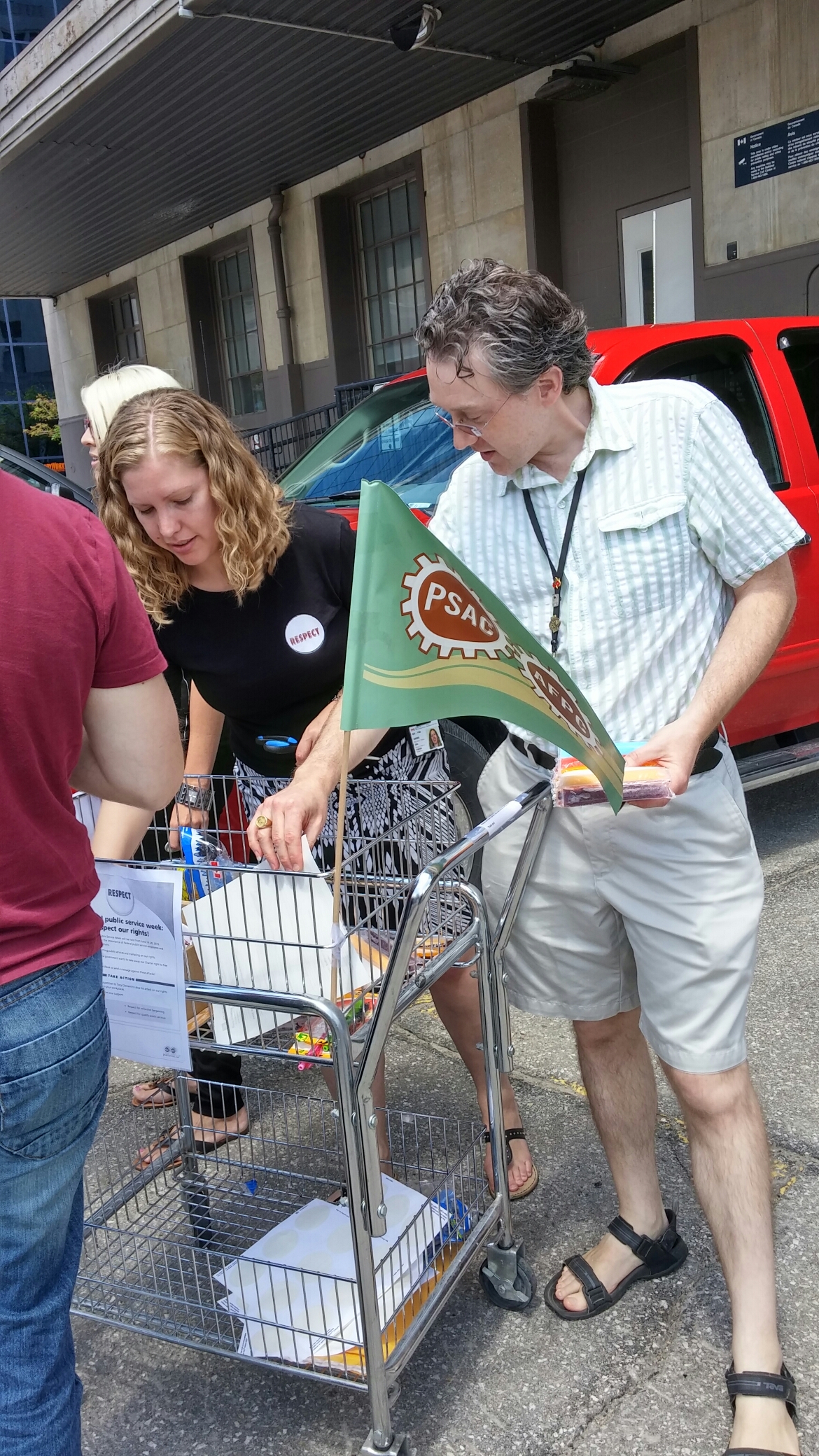
Federal public service unions united to defend their right to collective bargaining

Federal public service unions are united in their opposition to the Conservative government’s plan to unilaterally eliminate the existing sick leave provisions in their collective agreements. In a meeting today, the federal public service unions, which together represent more than 166,000 employees, agreed to develop a common response to the federal government’s proposal. 

via Federal public service unions united to defend their right to collective bargaining.

Canada’s truthiest election campaign begins: Don Pittis

stephen-colbert-truthiness
True or not, politicians defend their promises with passion and confidence
By Don Pittis, CBC News Posted: Apr 23, 2015 5:00 AM ET|

The Harper Conservatives are the balanced-budget party. You might as well get that into your head now, because you are going to be hearing it repeated till election day.

This is also the economic stewardship party, the spending-on-transit party and the party fighting for the poor and middle class. Yesterday, Finance Minister Joe Oliver even implied they were the fight-against-climate-change party.

An independent analyst might dispute those statements. In fact, independent analysts in newspapers and columns across the country have been doing just that this week following Oliver’s federal budget. But in what is shaping up to be Canada’s “truthiest” election campaign, scientific evidence doesn’t strictly matter.

■Joe Oliver’s budget: Ignore the sleight of hand
■Conservatives dig into contingency to hit surplus
Truthiness, as coined by U.S. comedian Stephen Colbert, is something expressed as a truth because it is a feeling from the heart without evidence or logic.

After reading a wonderful piece by Oxford economist John Kay called “How beliefs became truths for the political establishment,” it struck me that this is exactly what we are seeing in our own Canadian (pre-) election campaign.

As well as claiming a balanced budget, Oliver promised spending on transit and other infrastructure and tax breaks that would stimulate the economy. But there may be less substance to these boasts than appear.

Economical with the truth
There is nothing new in the accusation that politicians are economical with the truth. In fact, in a system like Canada’s, where caucus solidarity is so strongly enforced, the ability to lie with a straight face is essential for survival. That’s because no matter what your true feelings are on any issue, you must always speak and act as if the party line is actually your own.

As well as claiming a balanced budget, Finance Minister Joe Oliver promised spending on transit and other infrastructure and tax breaks that would stimulate the economy. (The Canadian Press)

But truthiness is different. Instead of just white lies to make sure everyone sings from the same songbook, with truthiness, the party view becomes an article of faith.

“Truthiness is the belief that comes when conviction is prized over information,” Kay wrote in Tuesday’s Financial Times.

Kay refers to the case of U.S. presidential candidate Rick Santorum, who once maintained that the elderly in the Netherlands were being “euthanized involuntarily.” When Dutch citizens complained it was factually not true, a Santorum aide justified the statement on the grounds that the politician “says what’s in his heart.”

Kay says conservatives do not have a lock on truthiness, quoting a Guardian commentator who insisted that we should believe Rolling Stone magazine’s alleged rape victim at the University of Virginia on principle, even after her accusations were disproved.

Partisan conclusions
In elections, the danger implied in truthiness is that it takes dishonesty an extra step so that it cannot be honestly challenged. And that is one more nail in the coffin of evidence-based democracy.

Instead of a careful examination of issues and their consequences, we jump, first, to partisan conclusions. It represents the destruction of Socratic logic, so we no longer examine the thesis, then the antithesis and come to a synthesis. Why bother? We already know the answers.

It is true that scientific evidence can be interpreted in many ways. Economics is even less stable ground, with each economist offering a different description of what is happening in the world.

But in this Canadian pre-election campaign, we are entering a never-never-land where facts seem to have become unimportant.

According to the Bank of Canada, the economy grew at zero percent at the beginning of the year – yet Oliver takes credit for wise financial stewardship. Spending for promises such as infrastructure projects doesn’t kick in until after the election, when the Conservatives may not even be in power. And as almost everyone except our finance minister has observed, balancing a budget with contingency reserves and assets sales is balancing in name only.

The truth behind truthy
The odd thing is that speaking a truth all of us can believe may have helped the government more than it hurt. It may well be true that cutting taxes is the best of all forms of stimulus. It may be that helping well-off Canadians with income splitting and higher limits on tax-free savings accounts will help the entire economy, creating capital pools and motivating the poor.

It may be that Conservatives truly believe climate change is not true, or not a problem. If so, they should tell us why it is so, not send the environment minister to accuse the provinces of not doing enough to mitigate it or the natural resources minister to boast of the government’s “already exemplary record of environmental performance.”

■Ottawa says provinces fall short on greenhouse gas cuts
I’m not sure the comments section below this column is an accurate sample of the Canadian electorate, but I am often disturbed by the polarized and “truthy” debate from those who support the Harper government and those who come to opposing conclusions, writing from the heart, not the head.

Truthiness is the home and refuge of the true believer. Each party has those, and we know which way they will vote.

But elections are decided by the undecided. As the New Democrats, Liberals, Greens and others begin to bring out their own platforms, the voters who count will be the ones who look for the truth behind the truthy.

7 Times Joe Oliver’s Budget Speech Departs from Reality

APR 21, 2015 by PressProgress
Hyperbole alert!
Finance Minister Joe Oliver delivered his budget on Tuesday. Here’s seven problems with what Oliver had to say about the state of Canada’s fiscal affairs:
1. But is the world an ocean of chaos? And is Canada an island of stability?
Joe Oliver says:
“Around the world, many nations — including some of our friends and allies — remain mired in a struggle for fiscal security … Still the news for Canada is, by and large, good. Amid the tumult, our country remains a beacon of economic stability and security built on a foundation of sound financial management.”
Reality check:
According to Oliver’s own budget, the recent drop in oil prices is going to mean chaos for Canada.
“As a producer and net exporter of crude oil,” the budget says Canada will see “a significant downward revision to the outlook for economy-wide prices and therefore, nominal GDP.” And what of the rest of the world? Low oil prices “will be generally positive for global growth,” says the budget — particularly for countries that import oil.
But although it projects “weaker investment and hiring within the energy sector,” the government says low oil prices could (eventually) lead to “positive impacts” for other sectors of the economy. Just probably not in the near future.
2. Is Canadian economic growth, in fact, “solid”?
Joe Oliver says:
“Mr. Speaker, our economy is now substantially larger than it was pre-recession, a performance that remains the envy of the G-7. International observers expect Canada’s growth — already ahead of our peers during the recovery — to continue to be solid…”
Reality check:
According to the Department of Finance, private sector economists say “economic data to date for early 2015 suggest the real GDP growth in the first quarter is likely to be weaker than expected, or even flat.” Economists now say real GDP growth will fall to 1.2% in the first quarter of 2015, while projections for nominal GDP growth over the year have been reduced from 4.3% to 1.6%.
What else? Economists predict oil prices won’t rise above $65 this year, and predict a gradual climb to $80 by 2019 (in other words, even after four years, oil isn’t expected to return to recent highs).
But since he seems to think the economy is so “solid,” maybe that explains why the budget doesn’t really include anything to stabilize Alberta’s economy?
3. If Canada is the story of “opportunity,” is this the chapter where “opportunity” takes a nap?
Joe Oliver says:
“The story of Canada is — has always been — the story of opportunity. Opportunity is what has drawn people here from around the world, generation after generation … Opportunity for themselves and for their families, the opportunity to work hard, dream big, and achieve those dreams.”
Reality check:
How’s the Canadian dream doing?
“Lower employment in the energy sector will have some negative effects on household income,” the budget says. And “lower equity prices in the energy sector will have an impact on household wealth, which could mostly reduce consumer spending.”
So, the story of Canada is the story of fewer jobs, lower incomes and less money in the bank?
4. Is reducing revenues to historic lows something worth bragging about?
Joe Oliver says:
“We have cut taxes to their lowest level in more than half a century.”
Reality check:
While the Conservatives can correctly take credit for reducing revenues to historic lows, it’s not clear that’s something worth taking credit for — that’s the reason Canada didn’t have a balanced budget in the first place.

And you don’t really think average families are the ones who’ve benefitted from all these tax cuts, do you?
• Income splitting: A $2 billion tax cut that mainly benefits the wealthiest families in Canada.
• Tax Free Savings Accounts: The Conservatives will double the TFSA contribution limit to $10,000 per year, amounting to a $300 million loss in revenue over five years. However, as explained in a recent Broadbent Institute report authored by TFSA architect Jonathan Rhys Kesselman, “a doubled TFSA would be heavily tilted toward high-income earners and wealth holders” since they are more likely to have an extra $5,000 lying around to put in a TFSA.
• Corporate tax cuts: The Conservatives’ reductions to the corporate tax rate have led to an estimated annual loss of $12 billion in revenue. Corporate Canada currently sits on a $600 billion hoard of unused ‘dead money.’
• Boutique tax credits: And while many of the Conservatives’ boutique tax credits aimed at children and families sound good in theory, many of them amount to “meaningless” savings for typical families. In fact, both by the way they’re structured and how they’re used, these tax credits more often than not skew to benefit wealthy Canadians.
5. Why are Conservatives taking credit for paying down the debt if they didn’t do anything?
Joe Oliver says:
“When our government first came to power, we worked hard to reduce Canada’s substantial federal debt. We did it in short order, by more than $37 billion.”
Reality check:
Earlier this week, former senior Finance Canada policy experts Scott Clark and Peter Devries described Oliver’s history of Canadian finances as pure “fantasy economics.”

Here’s what Clark and Devries has to say about the Conservatives’ fiscal record:
“How does this compare to the Harper government’s fiscal record? In 2006-07, the Conservatives inherited a surplus of $13.8 billion — which they turned into a deficit of $5.8 billion within two years.

Since then, they have been in deficit each and every year. In 2009-10, the deficit reached its peak of 3.5 per cent of GDP. They are desperate now to show a surplus in 2015-16 — one surplus in nine years. Since Harper was elected, the federal debt has increased by over $150 billion.”
6. Can you borrow your way to prosperity or can’t you?
Joe Oliver says:
“We cannot borrow our way to prosperity — no matter what our opponents might say.”
Reality check:
But a short time later, Oliver says “in times of crisis, a deficit may be the appropriate action.”
So can you or can’t you? Both these statements can’t be true.
7. Joe Oliver, how dumb do you think Canadians are, really?
Joe Oliver says:
“We are the only government in our nation’s history to reduce Canada’s greenhouse gas emissions — proof that emissions can decline even as economic growth increases.”
Reality check:
Really? The same government led by Stephen Harper, who only a few short months ago called the idea of reducing carbon emissions a “crazy economic policy”?

WE WILL PROTECT OUR SICK LEAVE

The federal government announced in the budget that it plans to eliminate the existing sick leave provisions for federal public service workers, whether or not an agreement is reached at the bargaining table.
All PSAC members should know that our union will not be intimidated by this threat. Any move by the government to make unilateral changes to our collective agreement is a violation of our constitutional Charter rights to bargain collectively without government interference.
We will vigorously defend our sick leave.
Our members have said it must be our top priority.
Over the next few weeks, we will be consulting with you to determine what actions we will take. We will start at the union’s national convention where more than 700 leaders will be meeting.
The government’s “go to work sick” plan is a step in the wrong direction. The Parliamentary Budget Officer and Statistics Canada have refuted all claims by this government that sick leave is a burden on Canadians. On the contrary – it is essential to maintain a healthy workplace and quality public services.
Please go to psacunion.ca for more information about the budget.
Sign up on the website to receive updates on the situation by email.
With your support, we can defend our rights.
In solidarity,
Robyn Benson
National President

Government threatens collective bargaining rights in federal budget

The federal government said today it will eliminate the existing sick leave provisions for federal public service workers, whether or not an agreement is reached at the bargaining table.
“The government is putting a time limit on the collective bargaining process and trying to pre-determine the outcome of bargaining, ” said Robyn Benson, PSAC National President. “That’s simply unacceptable. ”
“We will be consulting with our members to determine what actions we will take to defend our constitutionally protected collective bargaining rights. We will start next week at the union’s national convention where more than 700 leaders will be meeting.”
The government’s “go to work sick” plan is a step in the wrong direction. The Parliamentary Budget Officer and Statistics Canada have refuted all claims by this government that sick leave is a burden on Canadians. On the contrary – it is essential to maintain a healthy workplace and quality public services.
“Our focus is always to strengthen public services and ensure a healthy workplace,” said Benson. “The government is threatening to derail an ongoing bargaining process that was delivering positive results for the government, our members and the Canadian public.”
Public service cuts continue
The government’s operational freeze will continue for the 2015-16 fiscal year and it projects that it will lapse on billions of dollars of program expenditures. These are back-door cuts that will have a significant impact on public services.
“The government has devastated public services and they seem intent on going into an election with plans to make it worse,” said Benson.
Instead of using the EI surplus to fund greater access to job training so Canadians can get back to work, the government plans to cut EI premiums.

CEIU (our component) – changes in leadership

Important Message for our members
This message is to advise our members that as a result of personal choice, Brother Steve McCuaig has made the decision to resign in his capacity as National President of CEIU.
Our NEVP, Brother Marco Angeli, has therefore been sworn in as National President and Sister Michelle Henderson has been sworn in as the National Executive Vice-President. The National Executive, at their meeting this weekend, will amongst themselves, elect an Alternate to the National Executive Vice-President for the remainder of the term of office as per the National By-Law 12.4.3.
Our National Executive pledges to you, our members, that we will work in solidarity. Our primary focus is on our membership. We ask you to respect the privacy of Brother McCuaig, and we thank him for his years of service to our component.
As we move forward, the onus of responsibility is on all of us to stand together against this governments assaults on the rights of workers and on our collective agreements. In 2015, we have the opportunity to elect a government who is both progressive and labour friendly. What we can achieve together is limitless. And the only way that we will accomplish our goals, is united.
Solidarity forever, sisters and brothers.
On Behalf of the CEIU National Executive

AND
Effective immediately the following changes have been made to the CEIU Ontario leadership. (NVP’s)

Travis Lanhalampi will replace Jacqueline Wheway-Bacon
Bruce Flannigan will replace Nicole Ma
Valerie Fargey’s position does not change.

There is now a vacancy on Ontario Council for a HRSDC rep as this was Bruce’s previous position on Ontario Council.

TREASURY BOARD DELAYS IMPLEMENTATION OF SHORT TERM DISABILITY PLAN

April 17, 2015 — Negotiators for members of PIPSC’s SH Group have been told by Treasury Board (TB) representatives that the federal government cannot meet its proposed implementation date of September 1st, 2016 for its new Short Term Disability (STD) plan.
While Treasury Board has been pressing Groups to receive a presentation about the government’s proposed Short Term Disability plan, the invitations were issued at the last minute which did not provide President Debi Daviau and Vice President Shannon Bittman with sufficient time to adjust their schedules and attend.
TB subsequently proposed additional dates to receive the sick leave presentation, and based on their more reasonable request, PIPSC will announce its agreement to receive the government’s presentation next week at the NR Table.

8 public service issues that should decide this federal election

http://psacunion.ca/8-public-service-issues-should-decide-federal

The 2015 election is an opportunity to set a different course for our country. When you go to the polls this year, bear in mind the Conservative government’s record on the public services Canadians depend on.

Child care
Fewer than 1 in 4 Canadian kids has access to regulated child care. The Conservatives abolished the federal-provincial-territorial funding agreements on childcare, cutting $1 billion out of childcare in Canada. Instead of making childcare affordable, the government introduced cash payments directly to parents, which represent only a small fraction of monthly childcare costs.

Job cuts
The Conservative government cut 26,000 jobs in the public service with plans to cut 9,000 more, putting families and local economies in jeopardy. These job cuts mean that 35,000 full-time jobs will have been permanently eliminated from the economy. The cuts have directly hurt front line public services.

Employment Insurance
Legislative changes to EI are hurting workers and economies in many communities in Canada. Fewer than 40% of laid off workers are now covered by EI, the lowest in 40 years.

Retirement Security
The government is planning legislation on target benefit pension plans that will erode pension benefits for workers and undermine existing pension plans, including those of our members. It also increased the age of eligibility for Old Age Security from 65 to 67 — a direct hit on the retirement security of the next generation of Canadians.

Health care
Because of federal cutbacks – estimated at $36 billion over the next decade and changes to the funding formula, our health care systems will soon face serious spending cuts and will not be sustainable.

Human rights
The Conservative government has been steadily reversing gains on women’s rights, including gutting pay equity for federal employees. The Conservatives have also cut funding to programs that support Aboriginal peoples, people with disabilities, immigrants and refugees and to civil society groups that are critical of the government.

Environment
Over the last decade, Canada has gone from having a good record on environmental protection, to one of the worst among industrialized countries. Environmental laws and standards have been gutted, and the government abandoned its Kyoto Accord commitment to reduce greenhouse gases.

Veterans
This government closed nine Veterans Affairs offices and cut hundreds of front line workers who provide services to veterans. As a result, many veterans are not getting access to the services they need.

Designating essential services positions

Designations are coming. This is some info. distributed by employer:

Frequently Asked Questions

General information

Q1. What are essential services?

A1. In the event of a strike, the Government of Canada must ensure that Canadians have access to essential services. The Public Service Labour Relations Act defines an essential service as “a service, facility or activity of the Government of Canada that is or will be, at any time, necessary for the safety or security of the public or a segment of the public.”

The following are examples of essential services in the government of Canada:

• border safety and security;
• correctional services;
• national security; and
• income and social security (most relevant to our department).

Q2. What does it mean to occupy a designated position?

A2. Under the Public Service Labour Relations Act, a person who occupies an essential services position:

• must exercise duties in the interest of the safety or security of the public; and
• must perform these duties in whole or in part at any particular time or after any specified period.

For those reasons, an employee who occupies such a position is prohibited by law from participating in a legal strike by members of his/her bargaining unit. The employee will continue to pay union dues.

Identifying essential services positions

Q3. Who decides which positions provide essential services and how?

A3. The employer [Treasury Board of Canada Secretariat (TBS)] has the exclusive right to designate essential positions to maintain the safety and security of the public in the event of a strike.

Determining whether or not a position is designated as essential is based on whether or not the position supports a government service, facility or activity that is, or will be, at any time, necessary for the safety or security of the public or a segment of the public.

Consult the Guidelines for Essential Services Designations for more information.

Q4. How did management select which positions to identify as essential within the same work unit?
A4. Management recognizes that multiple positions performing the same duties may exist in a work unit responsible for an essential service, but that in some cases, the entire unit does not need to be designated to support the essential service. In these cases, management was asked to consider the following principles when selecting essential position(s) in the work unit:

• avoid preferential treatment;
• use sound judgment;
• consider legal requirements such as providing bilingual services; and
• take into account operational requirements relating to the essential service.

Q5. Do positions designated as essential need to be reviewed at each new round of collective bargaining?

A5. Prior to each new round of collective bargaining, the employer (TBS) will complete a review of designated essential positions previously identified for that bargaining unit and provide the bargaining agent with any revisions, updates or changes to the list.

Q6. Once a position has been designated as essential, can the designation be changed or revoked?

A6. Yes. If the functions of a position evolve or change over time — for example, due to organizational restructuring, a change in service delivery or the creation/elimination of other positions — there may be a need to review the position to determine whether the designation is still warranted.

The employer (TBS) may designate a position or revoke a designation at any time as circumstances.

Consultations between TBS and bargaining agents
Q7. How is the union consulted on positions that have been designated as essential?

A7. Once the employer (TBS) has prepared a list of positions designated as essential in a bargaining unit, accompanied by the corresponding rationales, department and work location, a first designation notice is served to the bargaining agent. Following this first notice, the bargaining agent engages in a 60-day consultation period to provide feedback to the employer (TBS). After the 60-day consultation period ends, the employer (TBS) has 30 days to supply the bargaining agent with the final list of designated positions.

The employer (TBS) is responsible for representing all departments and agencies during consultations with bargaining agents.

Q8. Can members of the Local or National Union Executive Board or Shop Steward remain in designated positions?

A8. Whenever possible, management will take the necessary actions to avoid identifying a designated position occupied by a member of the Local or National Union Executive Board or Shop Steward.

Information for employees occupying essential services positions

Q9. What happens to an employee whose position is designated as essential?

A9. Once the employer (TBS) has supplied the bargaining agent with the final list of designated positions, departments and agencies must inform the employee by letter (hard copy or electronically) that the position he/she occupies has been determined to provide an essential service and that he/she is prohibited from participating in a strike. The employee will continue to pay union dues.

Q10. Which categories of employees will not receive the notification letter and will need to report to work during a labour dispute?

A10. The following categories of employees will not receive the notification letter and will need to report to work during a labour dispute:

– unrepresented employees [e.g. Executive Group (EX), Personnel Administration (PE)];
– excluded employees;
– term employees working under three months;
– casual employees;
– students; and
– part-time workers working less than one third of the regular hours.

Q11. What happens when an employee leaves the essential services position and is replaced by a new employee?

A11. As indicated in the notification letter, the notice is valid as long as the employee occupies the said position. Therefore, an appointed employee will be notified that he/she occupies an essential services position from the Labour Relations Director, Centre of Expertise, via the generic email address (NA-ServicesEssentiels_EssentialServices-GD).

Q12. Can employees occupying designated positions refuse to be designated?

A12. No. Management determined that the position was essential for the safety or security of the public. As a result, employees in designated positions must report to work and are prohibited from taking part in a strike. They must perform all duties of the position. However, they should not be asked to perform the duties of other positions